
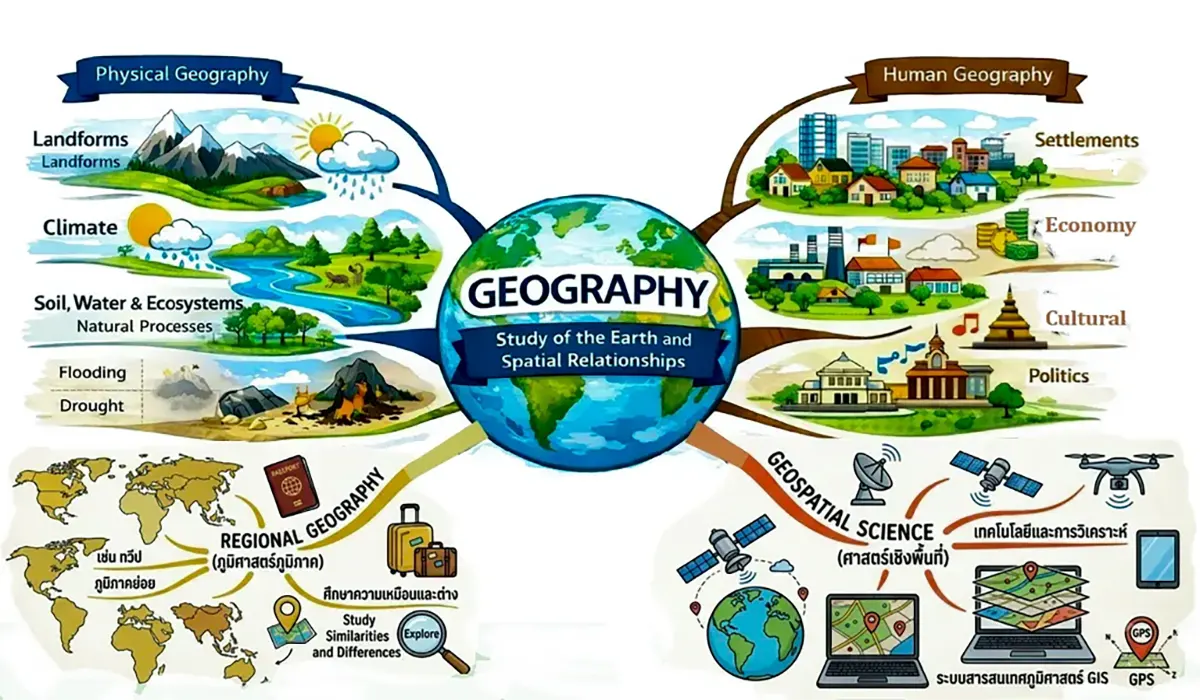
ภาพประกอบบางส่วนสร้างโดยเทคโนโลยี AI (Visual enhanced by AI technology)
Geography: ภูมิศาสตร์ (Geography) เป็นศาสตร์ที่ศึกษาและอธิบายในเรื่องของโลก มุ่งเน้นการอธิบายความแตกต่างและความสัมพันธ์ของปรากฏการณ์บนพื้นผิวโลก โดยการวิเคราะห์เชิงพื้นที่ (spatial analysis) และการทำความเข้าใจรูปแบบ (patterns) และกระบวนการ (processes) ของความสัมพันธ์ระหว่างมนุษย์กับสิ่งแวดล้อมในมิติของพื้นที่ โดยครอบคลุมทั้งลักษณะทางกายภาพและกิจกรรมของมนุษย์
การศึกษาที่เกี่ยวกับองค์ประกอบทางธรรมชาติ เช่น ภูมิประเทศ (landforms) ภูมิอากาศ (climate) ดิน น้ำ และระบบนิเวศ (ecosystems) การทำความเข้าใจกระบวนการทางธรรมชาติ เช่น การกัดเซาะ การเปลี่ยนแปลงของภูมิอากาศ การเกิดน้ำท่วม การเกิดภัยแล้ง ฯลฯ เนื้อหาเหล่านี้เราเรียกว่า ภูมิศาสตร์กายภาพ (Physical Geography)
ในขณะที่การศึกษาปรัชญา แนวคิดและกิจกรรมของมนุษย์ ตลอดจนความสัมพันธ์ที่เกิดขึ้นกับพื้นที่ เช่น การตั้งถิ่นฐาน เศรษฐกิจ วัฒนธรรม และการเมือง เราเรียกการศึกษาเนื้อหาเหล่านี้ว่า ภูมิศาสตร์มนุษย์ (Human Geography)
นอกจากนี้นักภูมิศาสตร์ยังใช้เทคนิคและเครื่องมือทางภูมิศาสตร์ศึกษาและอธิบายในเรื่องของโลก ซึ่งทำให้เกิดเนื้อหาและสาขาวิชาอื่นอีกมากมาย เช่น การใช้เทคนิคการแบ่งพื้นที่ตามลักษณะความเหมือนและแตกต่างโดยนักภูมิศาสตร์เรียกว่าว่า ภูมิศาสตร์ภูมิภาค (Regional Geography) ซึ่งเป็นแนวคิดที่ถูกนำมาใช้เป็นหลักในการศึกษาด้านการวางแผนและการวางผังเมือง และอื่น ๆ
สำหรับการใช้เทคนิค เครื่องมือและเทคโนโลยีวิเคราะห์ข้อมูลด้านการปฏิสัมพันธ์เชิงพื้นที่เพื่อแสดงผลและอธิบายสิ่งต่าง ๆ บนพื้นโลก นักภูมิศาสตร์นำแนวคิด เทคนิคและวิธีการของศาสตร์ทางพื้นที่ (Geospatial science) มาประยุกต์ใช้อย่างมีประสิทธิภาพ ซึ่งศาสตร์อื่น ๆ ก็ได้นำแนวทางนี้ไปประยุกต์ใช้ตามแนวคิดของศาสตร์นั้น ๆ ด้วยเช่นกัน เช่น วิศวกรรมการขนส่ง การสาธารณสุข(ระบาดวิทยา) ประชากรศาสตร์ เป็นต้น
Geography is the scientific study of the Earth and its spatial phenomena. It seeks to explain the differences, distributions, and relationships of phenomena occurring on the Earth's surface through spatial analysis and the understanding of spatial patterns and processes that shape the interactions between humans and the environment. Geography encompasses both the Earth's physical characteristics and human activities, providing a comprehensive perspective on the organization and dynamics of places and regions.
The study of natural components of the Earth—including landforms, climate, soils, water resources, and ecosystems—as well as natural processes such as erosion, climate change, flooding, drought, and other environmental phenomena, is known as Physical Geography. This branch of geography focuses on understanding the physical systems that shape the Earth's surface and influence environmental conditions.
In contrast, the study of human thought, behavior, and activities, together with their relationships to space and place—including settlement patterns, economic activities, culture, and political systems—is referred to as Human Geography. Human Geography examines how people organize, utilize, and transform space, and how human societies interact with their environments.
Geographers also employ a wide range of geographic techniques, methods, and analytical tools to investigate and explain the world. These approaches have given rise to several specialized branches of geography. For example, the classification of areas according to their similarities and differences forms the foundation of Regional Geography, which examines the distinctive characteristics of regions and provides an important framework for regional planning, urban and regional development, and spatial policy-making.
In addition, geographers apply advanced techniques, tools, and technologies to analyze spatial interactions and represent geographic phenomena. By integrating the concepts and methodologies of Geospatial Science, they are able to acquire, manage, analyze, visualize, and communicate spatial information effectively. Today, these geospatial approaches have been widely adopted beyond geography and are extensively applied in many disciplines, including transportation engineering, public health and epidemiology, demography, environmental management, urban planning, and numerous other fields that require spatial thinking and geographic analysis.