
ภาพประกอบบางส่วนสร้างโดยเทคโนโลยี AI (Visual enhanced by AI technology)
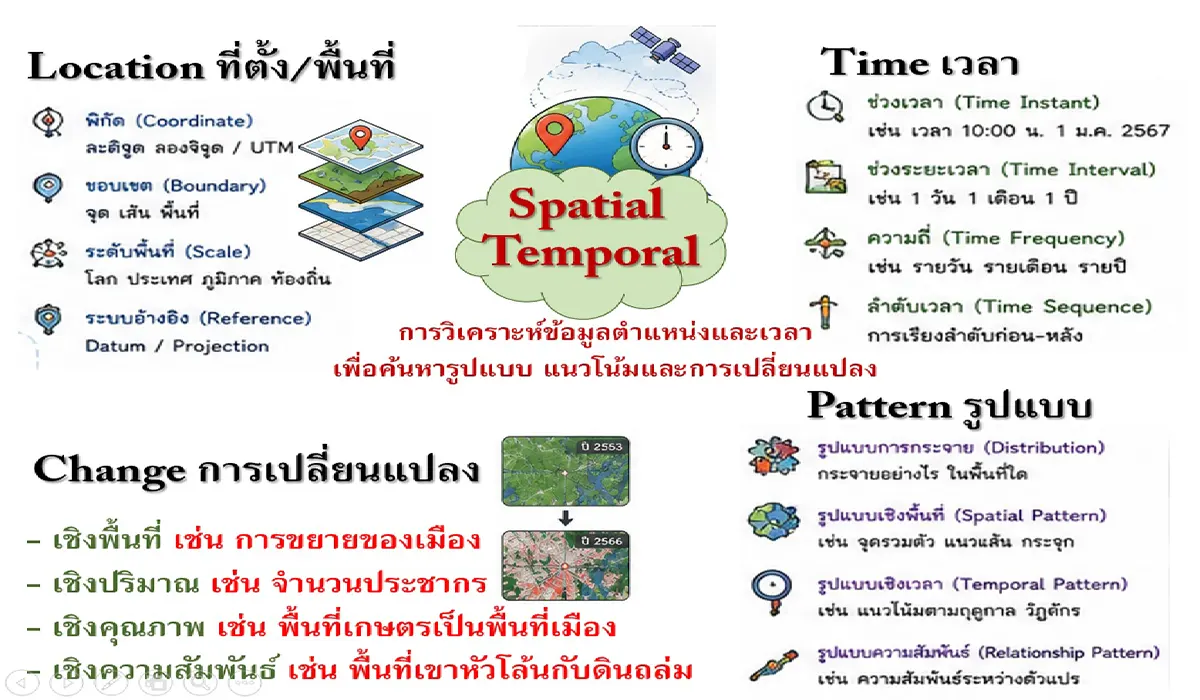
Spatial Temporal เป็นการศึกษาการเปลี่ยนแปลงของปรากฏการณ์ต่าง ๆ บนโลก ตามช่วงเวลา โดยวิเคราะห์การเปลี่ยนแปลงของข้อมูลทั้งด้านพื้นที่และเวลา เพื่อค้นหารูปแบบ แนวโน้ม และการเปลี่ยนแปลงของปรากฏการณ์ต่าง ๆ หากพิจารณาคำว่า Spatial Temporal จะพบว่ามีความสัมพันธ์เกี่ยวข้องกับ คำ 4 คำหลัก คือ
1) Location ระบุว่า ที่ไหน (Where)
2) Time ระบุว่า เมื่อไร (When)
3) Change บอกถึงการเปลี่ยนแปลง
4) Pattern บอกถึงรูปแบบของปรากฏการณ์
ดังนั้น Location + Time + Change + Pattern จึงเป็นแนวคิดของ Spatial Temporal หรือการทำความเข้าใจว่า สิ่งใดเกิดขึ้น ที่ไหน และเปลี่ยนแปลงอย่างไรเมื่อเวลาผ่านไป
Spatial-temporal analysis is the study of how geographic phenomena change over time. It examines variations in both space and time to identify patterns, trends, and the dynamics of change in natural and human-related phenomena. By integrating spatial and temporal dimensions, spatial-temporal analysis helps explain where events occur, when they occur, and how they evolve over time.
The concept of spatial-temporal analysis can be understood through four fundamental elements:
1. Location – Where does the phenomenon occur?
2. Time – When does it occur?
3. Change – How does the phenomenon change over time?
4. Pattern – What spatial or temporal patterns can be identified?
Together, these four elements—Location, Time, Change, and Pattern—form the foundation of spatial-temporal analysis. They provide a framework for understanding what happens, where it happens, when it happens, and how it changes through time. This perspective enables researchers and decision-makers to analyze the evolution of geographic phenomena, recognize emerging trends, and better understand the relationships between space and time.
Spatial-temporal analysis is widely applied in Geographic Information Systems (GIS), remote sensing, environmental monitoring, urban and regional planning, transportation analysis, epidemiology, disaster management, climate science, and many other disciplines that require an understanding of geographic processes across both space and time.